|
WHY CATS FAIL TO USE THE
LITTER BOX (Note: There's other info you might find useful on our Cat Behavior page, as well as perhaps other links you can find on our Downloads & Education page.) We're not veterinarians, nor are we certified animal behaviorists. That said, though, we’ve certainly fought our way through most of the common cat behavior issues over the last quarter century. We’ve cared for and found homes for many hundreds of animals over the years. We've also read extensively about litter box habits and have attended numerous conferences on cat behavior, so as they say, we have QBE ("qualified by experience") degrees in cat litter box habits. Over the years, we've had our share of litter box debacles, too, and have managed to work through them in one way or another, so we hope our brief discussion here will offer you some hope about dealing with the issues you’re going through. Causes Of Poor Litter Box Behavior Certainly some cats do get cystitis or Feline Urological Syndrome (FUS, which is the formation of crystals or sludge, generally in the bladder, which causes irritation, bleeding and sometimes blockage of the urethra or ureter, making it difficult or impossible for a cat to urinate), so a medical cause should always be ruled out. If a cat is going to the litter box frequently or, once there, is spending a long time squatting in the box—and perhaps is crying while in the box—a trip to the vet is definitely needed. Frequent & large-volume urination can be a sign of diabetes; squatting for a long time, straining & crying can signal FUS. Either of these maladies can be quite serious and should be checked out promptly by your veterinarian. But what if the cat isn't exhibiting either of these characteristics? This is where common sense and psychology come into play. It's time to think like your cat. It's time to figure out what's discouraging your cat from using the litter box properly. It's time to implement, as we like to say, some "Dung Shui™." The Litter Box Itself Cats' sense of smell is estimated by scientists to be 1000 times stronger than that of humans. As such, they're much more attune to changes in appearance and scent than we are, which can sometimes be the cause of a change of litter box habits. Cats have sometimes been known to exhibit poor litter box compliance because of a new smell in their home, on their owner or on a new visitor. As is evidenced by our cats' behavior when inclement weather is approaching or an earthquake is imminent, they're also much more sensitive to vibration than we are. Think about it. Have you ever seen a cat "freak out" when the furnace comes on for the first time in the fall? Cats spend most of their time on the floor, where they're much more likely to feel the rumble of the furnace than we are "all the way up here." What does this have to do with litter box habits? Plenty, as far as some cats are concerned. Many folks place their litter boxes in the basement, often near the furnace or washing machine. Over the years, we've heard of cats who wouldn't use the litter box if it was too near the furnace or washer due to all the vibration and racket these machines can cause. We've also seen cats who would use the box in that location for awhile, then one day simply decide they were tired of the lousy bathroom ambiance and fail to use the box any more. So, pay attention to where your litter box is...from your cat's perspective. How would it seem to you if you were the kitty? Cats can also be skittish (duh #2) and are prone to feeling trapped, so experts recommend that the litter box be positioned in such a way as to offer more than one approach and/or escape route. This is especially important if your household contains more than one cat, as none of us wants to be sneaked up on while we're going potty. (I know I personally hate it when that happens!) Putting the box in a far away corner that leaves your cat no options is a no-no, especially if one of your cats tends to bully the other(s). The litter box needs to feel safe to your cat. The surface that the box rests on also seems to be key to some cats. Experts have found that some cats prefer the box to be on a hard surface, while some appear to prefer it on a soft surface. As we all know, some cats have been known to go potty far away from the litter box on the hardwood floor in the dining room, while others have been known to go potty in the corner of the carpeted living room. Most of the times when cats do this, they're trying to tell us that there's something wrong with their litter box setup. Outside Influences Most of us have cats who love to hang around by the window watching the world go by. This is by and large fine...until another cat, a dog, a groundhog, a squirrel, a large bird or another small animal comes into view. Then, our cats feel threatened and act as if their territories have been invaded. Even though we as humans can differentiate between inside the house and outside the house, to our cats the "intruder" is just feet away and is perceived as a substantial threat. Experience has shown us that cats seem unable to understand the concept of glass as a barrier. If a strange cat comes by once and then never again, your housecat will likely not begin exhibiting poor litter box behavior. However, if the cat prowls by every night, sooner or later your cat is probably going to get fed up and may show this displeasure in an undesirable way. Experts we've heard speak have recounted quite a few stories of cats whose poor litter box behavior was traced to outside animals intruding into the cats' perceived territories. When the owners built tall fences, called Animal Control to come pick up the stray cats or convinced their neighbors to keep their cats (or dogs) in their houses where they belong, the bad behavior subsided. Some owners have noticed their problems disappear when they added on to their homes, thus occluding certain views from their cats. A home with high windows a cat couldn't see out of might be perceived by us humans as boring for the cat, but I can pretty much guarantee that the cat wouldn't ever exhibit poor litter box behavior due to outside influences. Types Of Cat Litter Conventional litter is less expensive to buy, but it quickly gets urine-soaked and must be thrown away every few days, lest your home begin to smell like an outhouse. Clumping litter is the type that forms into a ball when the cat urinates. This type is inherently cleaner because we just scoop out the feces and urine balls, throw them in the trash (NEVER flush clumping litter) and the box is, in theory at least, as clean as it ever was. Not only that, because we're not tossing all the litter every few days, we're saving money and helping the environment. Clumping litter may be perceived as being more expensive than conventional litter, but once you figure that you're not throwing the baby out with the bathwater, so to speak, you'll realize that it's actually a lot less expensive. It bears mentioning here that not all clumping litters are the same. Without getting too deep into the science of clay, suffice it to say that we have done a L-O-T of research into clay and all the various types that are mined in the United States, let alone the rest of the world. Some brands of litter use the "off-fall" (waste) clay after it's been used in the manufacture of other products; this is typically why some less-expensive brands are so dusty. Some brands use clay that's inherently more plentiful and less expensive, but which doesn't clump as tightly when a kitty urinates. Both of these factors yield results that are less than desirable. The looser the clumping, the more the urine balls break up in the box, thus emanating more odor and dissuading kitty from using the box. DooDoo Voodoo Clumping Cat Litter is different. It features the tightest-clumping, lowest-dust clay we know of. It is 100% natural and is not bleached, colorized or fragranced like other brands can be. It is mined, dried and bagged. That's it! We've used it exclusively since 1988, which is when we began to sell it. Just like DooDoo Voodoo Earth-Friendly Pet Odor & Stain Remover, when we describe our litter we say that It's Science, But It Works Like Magic! ® A top veterinarian we know said, "I'm going to tell every cat owner I know that they have GOT to use this litter!"In addition, clumping litter offers a benefit that is important to talk about in a discussion of litter box habits: it is significantly softer under a cat's paws and feels more like the earth he's used to "in the wild" (even if he's been an inside cat all his life, he's got eons of "in the wild" in his genes). Studies have shown that, given a choice, most cats—especially declawed cats—prefer clumping litter to conventional litter—both for its texture and for its inherently increased degree of cleanliness. If you've had some outside-the-litter-box activity lately, perhaps you should give clumping litter a try. Even the best clumping litter can get gnarly after months of use, so even if you only have one cat in your household, dump all the litter if your nose or your cat tells you to and disinfect the litter box. Your cat will thank you for it. We dump our DooDoo Voodoo Clumping Cat Litter (available through our website) twice a year—but we have lots of cats in our rescue facility, many with special needs.
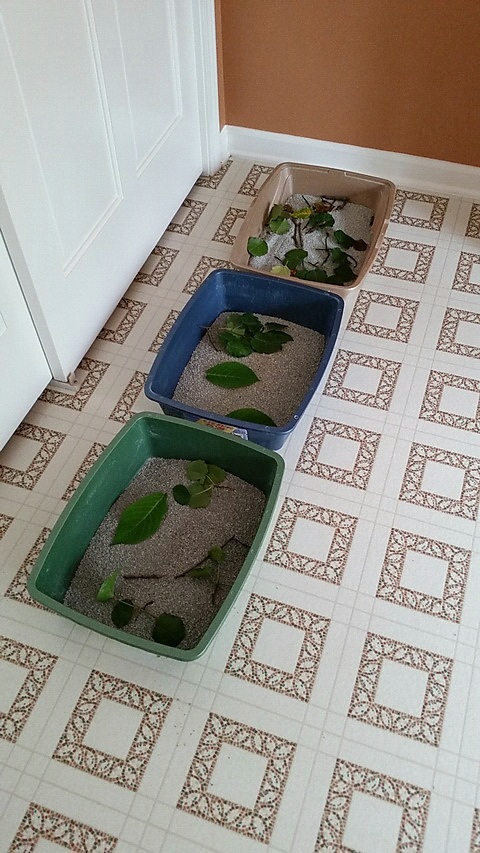
The green box is Touch of Outdoors; the blue box is Cat Attract and the brown box is DooDoo Voodoo Cat Litter. The jury is still out on whether the kitty is going to acclimate to using the litter box and, if so, which litter will attract her. [Update: She did and she is a total lovebug. We're really glad to have her in our family. She causes us no troubles whatsoever, except she wants to be petted all the time.] Even if you're not trying to tame a feral like we are, these two Dr. Elsey's litters might help your cat decide that the litter box isn't such a bad place to be. Other Factors That Can Influence Your Cat Call Me Mr. Obvious
We began paying even more attention to Gracie than we had been. We closed off the rooms of the house where she'd done her business—except the living room, which was impossible to restrict access to. This was back before we perfected DooDoo Voodoo’s formula, so we pulled the carpet back, cleaned the areas with strong mixtures of readily-available household cleaners, sealed the subflooring with BIN by Zinsser (a KILZ-type product we’ve found to be more effective), replaced the carpet pad & tack strips, then had the carpet professionally steam cleaned on both sides. In these areas, we applied our odor neutralizer, the formula for which didn’t work nearly as well as DooDoo Voodoo now does, then reapplied it, then reapplied it. After a while, the urine odor was gone and all that remained was a faint aroma of the odor neutralizer. Our technique worked so well, as it has for many people we've advised over the years, that for the last few years we've given the cats access to the previously-soiled areas and they no longer urinate there. (You can see pictures of the soiled areas in our brochure and on our website.) Visitors to our home have no idea that there has ever been urination on our carpet. They don’t see it, and they don’t smell it. Luckily, now that DooDoo Voodoo’s formula has been perfected, all the work we went through isn’t necessary for most folks. Years have passed and, largely due to the way we make it a point to interact with Gracie and the other cats (all of whom are still living in the house with us, by the way), the cats have not re-soiled the areas, and they all now get along great. Gracie and the two other females in the house are now quite good friends and often curl up together; Gracie has convinced the males that she is, indeed, the Alpha Cat and they've agreed to her terms and conditions. Whereas many people would've relinquished or euthanized Gracie and possibly some of the other cats, we stuck it out, showered Gracie with kindness, cleaned up the messes to the best of our abilities and, lo and behold, everything turned out as well as it possibly could have. Never give up. Backed Up Against The Wall Unfortunately, there are some cats—and not all of them are male—who will just seem to consistently go potty outside the litter box. When this occurs, it's our opinion that one of a few things is happening. (1) Either the cat lives in a multi-cat household and will forever WANT to be the Alpha Cat even though he or she ISN'T the Alpha Cat, or (2) one of the other stimuli talked about in this article is having an effect, or (3) there was another animal—most likely a cat—in the house before and the current cat can still smell the previous cat's scent (sometimes this could be urine-related, but it doesn't have to be). In our highly cleanable rescue facility, we have had two males who perpetually urinate(d) outside the litter box in what is, quite literally, a peeing contest. One was with us for over 16 years and had kidney failure, heart disease and diabetes, so we just got used to cleaning up after him. (He passed away not long ago.) The other is younger and you'd never guess he'd so badly want to be the Alpha Cat, but he does. If we were to place him up for adoption and find him a good, single-cat home where he could be the king, we'd bet you a case of DooDoo Voodoo that he'd give up his undesirable behavior. (Note: after writing this article, we did find him a home, and he never again exhibited his behavior. Unfortunately, the adopter lost her job and made the decision to move cross-country, so she brought JimBob back to us, where he now, again, pees outside the litter box. She absolutely swears he did NOT do this at her house. We pushed and pushed her to see if she was telling the truth, and she swears he did not pee. This is a testimony to his only peeing when he feels as if he's not the Alpha Cat, such as in our rescue facility's population.) The Recap If you've tried everything you can think of and you're still having no luck, we urge you to set up an appointment with a certified animal behaviorist. Their fresh perspective and training can sometimes lead them to a solution you've never dreamed of. Another option we suggest is talking with an animal communicator. We've worked with Mary Marshall (www.medicinehorsewoman.com) and have had some astonishing readings. A good communicator will get so much right during a reading (over the phone, not in person where they could see the animal) that you'll come to feel, as we do, that there's no way they could be faking it. Even if this sounds "out there" to you, we urge you to consider it as a viable option. Give yourself and your pet(s) every opportunity to figure out your indiscriminate urination issues. Another Resource A Final Word Of Encouragement We at Four On The Floor appreciate your willingness to do the right thing. You’re to be commended for not taking the easy way out at the expense of your pet. Thank you. ►◄ P.S. Mrs. DooDoo Voodoo reminded me today that some cats have a strong aversion to the scent of those fabric softener sheets you throw in your clothes dryer. This can cause some cats to urinate on a pile of laundry even if they don't have issues with the litter box, the litter, the location of the litter box, etc. If this happens to you, remember that you can use DooDoo Voodoo in your washing machine in lieu of your regular detergent. Don't mix DooDoo Voodoo with any other product (such as laundry soap, pre-spotters, oxygen boosters, bleach, etc.). Added Information: On 10-31-08, we received an e-mail from a customer who had questions about why her cats were not using the litter box reliably. Here's my response. She was using plastic litter box liners and newspaper: "Yes, I believe that there are a few possible things going on here that are dissuading the cats from using the box. They're trying to tell you that they don't like something about their litter box, nearby environment, litter, etc. We'll get to the bottom of it, so to speak. One could be location, as detailed in our article, Why Cats Fail To Use The Litter Box. I've seen cats acutely develop an aversion to the box location, even after a long period of no such aversion. This could be due to the furnace, washing machine, toilet, etc. Another, often overlooked, aspect is the surface the box is on. Hard surfaces are better than soft (carpet), as cats prefer soft surfaces to poop/pee on. Your kitties may actually prefer the surface surrounding the box to what's inside the box, hence their behavior of voiding right beside the litter box. Another could be the litter you're using. I suggest an all-natural clumping litter that is not bleached or fragranced. Keep 2.5-3" of litter in the box. Scoop often. Smooth out the top surface of the litter after scooping (it helps!), either by gently shaking the box side to side or by smoothing out the litter with your litter scoop. Buy a very tight-clumping litter, not a cheaper one that allows too much urine to stay in the box due to the clumps breaking up. A litter that is 100% bentonite clay is preferable to one that is a blend or another type of clay. Scoop at least once a day. Another is likely that the cats don't like the plastic liner, which most cats don't. I suggest not using a liner OR the newspaper, which has a very strong scent and is a deterrent to many cats' using their litter boxes. I and many other people are averse to the smell of newsprint, so given that cats' sense of smell is estimated to be a hundred times stronger than humans', I bet the cats are averse to the smell, too, and telling you so by exhibiting the behavior they are. We always suggest one more litter box than the number of cats, so I'd add one [the customer has two cats and was using two boxes]. I bet you'll find that the cats pee in two and poop in one. Since you won't be using liners, I suggest periodically cleaning the box out with DooDoo Voodoo, letting it dwell for at least 10 minutes, then wiping it out with paper towels. Setting the box in the sun to fully dry helps with odor eradication after the DooDoo Voodoo is wiped out (don't wipe the box quite fully dry before setting it in the sun to dry and "bake"; the ultraviolet light helps maximize DooDoo Voodoo's effectiveness at eradicating the odor-causing organic material in the plastic). I am confident that following these guidelines will yield the results you're looking for by giving the kitties the secure, comfortable elimination environment they desire. Let me know how it goes!" ### Eric and Julie Smith are the founders of two federally-licensed animal charities and for some time operated a nonprofit, low-cost, feline-only spay/neuter clinic in Indianapolis. They have lectured on feral cat management and early-age spay/neuter at a statewide veterinary conference held at the Purdue School of Veterinary Medicine and were the founders of the Indy Pets ALIVE! coalition. Because of their work on behalf of animals, they have been featured many times in newspapers and magazines, as well as on television and radio. They founded Four On The Floor Pet Products, Inc., in 1988. Up to the limit allowed by federal charitable-giving laws, profits from the sale of Four On The Floor’s products are funneled back into work on behalf of needy animals.
|